The Silent Majority Problem
Here's an uncomfortable truth for most local businesses: the vast majority of satisfied customers never leave a review. Not because they didn't have a good experience — they simply forget, or the moment passes before anyone asks them to.
Meanwhile, the customer who had one bad interaction? They're far more likely to leave a review, unprompted, within hours. The result is a reputation gap that doesn't reflect reality — it reflects who bothered to speak up.
For real estate agents, home services companies, dental practices, and legal firms, this gap directly affects revenue. Star ratings and review volume are now some of the strongest local ranking signals on Google, and they're often the deciding factor when a prospect is choosing between three similar businesses in their area.
Why Manual Review Requests Fail
Most businesses know they should ask for reviews. Very few do it consistently. Here's why:
- Timing is everything, and humans forget. The best moment to ask is right after a positive interaction — not three weeks later in a generic email blast.
- Front-desk staff are busy. Asking every customer for a review, every single time, isn't realistic when someone is juggling phones, walk-ins, and paperwork.
- Awkwardness. Many staff feel uncomfortable directly asking for a 5-star review, so they skip it entirely.
- No tracking. Without a system, there's no way to know who's already been asked, who left a review, and who needs a gentle follow-up.
The result is a trickle of reviews instead of a steady stream — and a star rating that lags behind the quality of service actually being delivered.
How an AI Agent Fixes the Review Gap
An AI agent built for review generation solves this by treating review requests the same way it treats lead follow-up: as a process, not a hope. Here's what that looks like in practice.
1. Automatic trigger after service completion
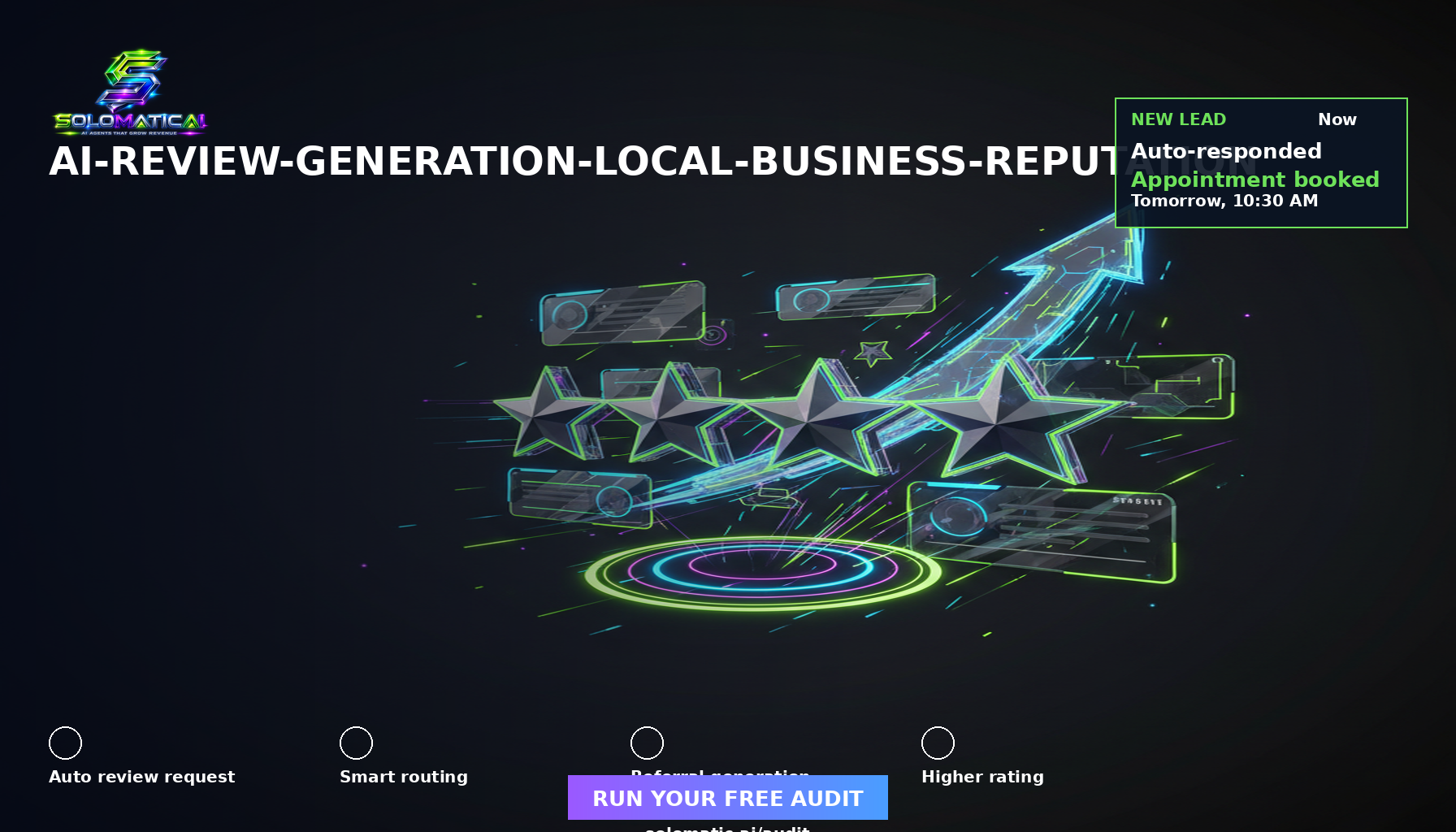
The moment a job is marked complete, an appointment is closed, or an invoice is paid, the AI agent triggers a review request — via SMS or email — while the experience is still fresh in the customer's mind.
2. Smart routing based on sentiment
Before asking for a public review, the AI agent can ask a quick private question: "How would you rate your experience today?" A high score routes the customer straight to your Google Business Profile or Trustpilot link. A lower score routes them to a private feedback form instead — protecting your public rating while still capturing the concern internally so your team can follow up.
3. Personalised, non-generic messaging
Instead of a robotic "please leave us a review," the agent references the specific service completed, the technician's name, or the property address — making the request feel personal rather than automated.
4. Persistent, polite follow-up
If a customer doesn't respond to the first request, the agent follows up once or twice more over the following days, using a different angle each time, then stops — no nagging, no spam.
5. Full visibility for your team
Every request sent, every response, every review link clicked is logged, so you always know your review pipeline is actually working rather than just hoping it is.
The Business Impact
| Approach | Reviews per 100 Customers | Response Time | Staff Effort |
|---|---|---|---|
| No system (word of mouth) | 2-4 | Days to weeks | None |
| Manual staff requests | 8-12 | Inconsistent | High |
| AI agent automation | 25-35 | Minutes after service | Near zero |
The numbers vary by industry, but the pattern is consistent: automated, well-timed requests outperform manual efforts by a wide margin — without adding a single task to your team's day.
Why This Matters Beyond the Star Rating
Review volume and freshness affect more than vanity metrics. They influence:
- Local search visibility — Google factors in review recency and quantity for map pack rankings.
- Conversion rate on your website — Prospects who see recent, detailed reviews convert at noticeably higher rates than those who see a stagnant profile.
- Referral trust — A steady stream of specific, genuine reviews builds more credibility than a handful of old five-star ratings.
- Internal quality signals — The private feedback routing gives owners an early warning system for service issues, often before they escalate into public complaints.
Where This Fits Into a Bigger AI Strategy
Review generation rarely works well in isolation. It's most effective when it's connected to the same system that's already handling your leads, bookings, and follow-ups — because the trigger for a review request should come directly from a completed job or closed appointment, not a separate spreadsheet someone updates manually.
This is exactly how SoloMatic AI approaches it. Rather than selling a standalone review tool, SoloMatic AI builds review generation into the broader workflow of your AI agent — so the same system that answered the call, booked the appointment, and sent the reminder also handles the review request afterwards, with zero extra setup per customer.
Businesses exploring this can browse ready-built options in the agent store, or look at industry-specific bundles in kits designed for real estate, home services, medical, and legal teams specifically.
Getting Started
If you're not sure how many reviews you're currently losing, a good first step is running a quick audit of your current follow-up and review process. Most business owners are surprised by how much of the gap is simply timing — not customer satisfaction.
From there, the agents page walks through how review automation slots alongside lead response and scheduling, so you're not stitching together three different tools to manage one customer journey.
Final Thought
Your happiest customers aren't withholding reviews on purpose — they just need to be asked at the right moment, in the right way. An AI agent removes the guesswork, the awkwardness, and the inconsistency, replacing it with a system that quietly builds your reputation in the background while your team focuses on the work itself.
Ready to see what an automated review pipeline could look like for your business? Book a 30-minute call with SoloMatic AI and we'll walk through it live, using your own numbers.