Chatbot vs AI Agent: Why the Difference Matters More Than Ever
If you've shopped around for AI tools in the last year, you've probably seen the words "chatbot" and "AI agent" used almost interchangeably. Vendors love blurring the line because chatbots are cheap to build and AI agents sound impressive. But for a business owner trying to decide where to spend budget, the difference isn't semantic — it's the difference between a tool that answers questions and a system that actually runs part of your business for you.
Getting this wrong is expensive. Plenty of local businesses installed a chatbot in 2023 or 2024, saw it fail to convert leads, and concluded "AI doesn't work for us." In most cases, AI wasn't the problem. A chatbot was the wrong tool for the job.
What a Chatbot Actually Does
A traditional chatbot is a conversation engine. You type a question, it searches a script or knowledge base, and it returns an answer. Some are rule-based (if the customer says X, reply with Y). Others are powered by a language model and feel more natural, but the underlying job is the same: respond to what's typed in the box.
Chatbots are genuinely useful for:
- Answering FAQs on a website ("What are your hours?")
- Basic triage before a human takes over
- Simple, single-step interactions
What they don't do is take action. A chatbot can tell a customer your opening hours, but it can't check your calendar, book the appointment, send a confirmation text, and follow up three days later if the customer doesn't show. That requires something with memory, permissions, and the ability to trigger real-world tasks — which is where AI agents come in.
What an AI Agent Actually Does
An AI agent is built to complete a job, not just hold a conversation. It can read incoming messages or missed calls, decide what needs to happen next, take that action across your existing tools, and keep working the task over hours or days until it's resolved — all without a human clicking a single button.
For example, a properly built AI agent for a home services business could:
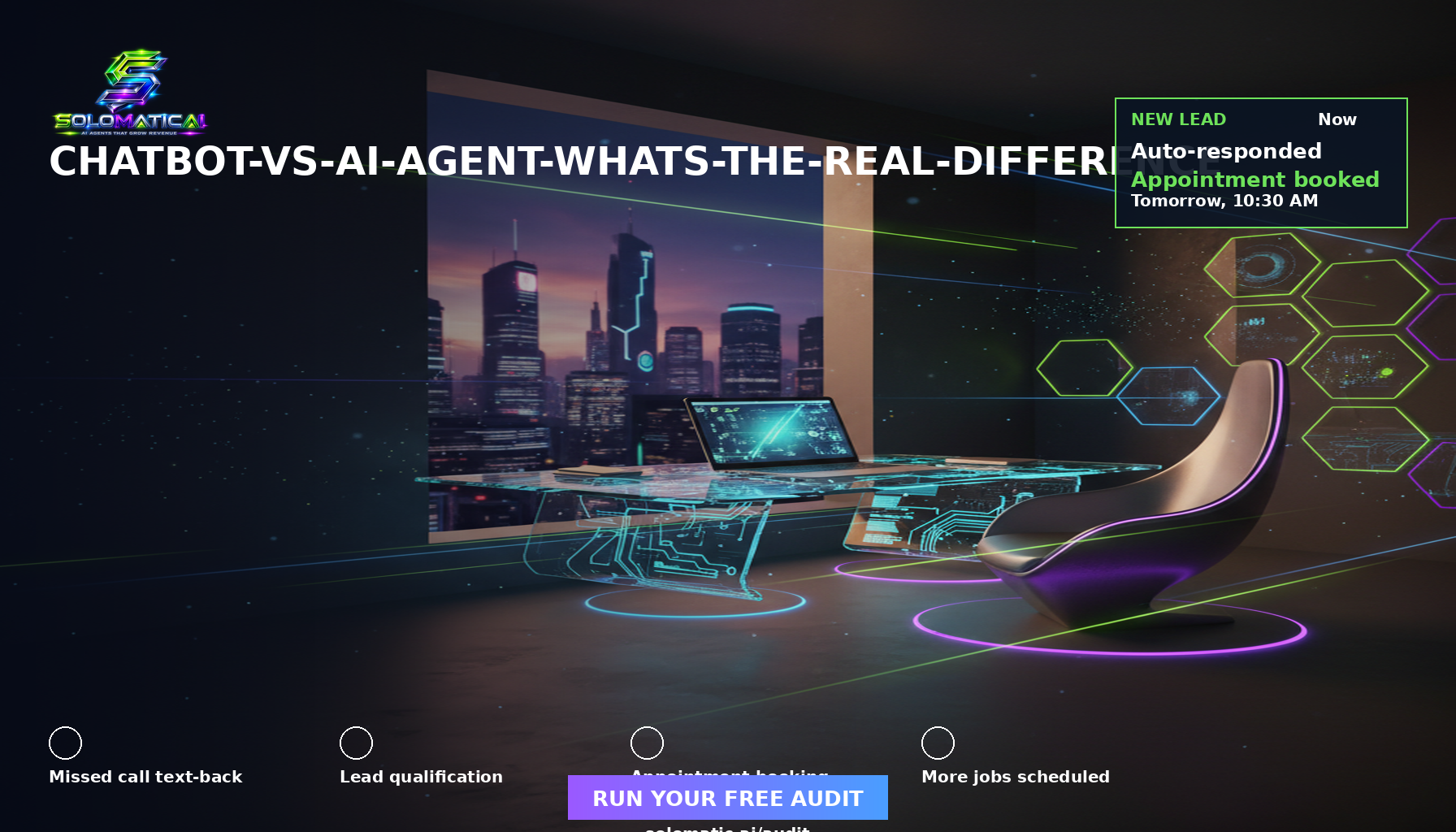
1. Detect a missed call and text the caller back within seconds 2. Ask qualifying questions (job type, location, urgency) 3. Check the calendar and offer real appointment slots 4. Book the job directly into the scheduling system 5. Send a confirmation and a reminder 24 hours later 6. Follow up with a review request once the job is marked complete
A chatbot could maybe handle step one or two. An AI agent handles the entire chain, end to end, and does it whether it's 2pm on a Tuesday or 11pm on a Saturday.
Side-by-Side Comparison
| Capability | Chatbot | AI Agent |
|---|---|---|
| Answers basic questions | Yes | Yes |
| Holds a natural conversation | Sometimes | Yes |
| Takes action in other systems (CRM, calendar, billing) | No | Yes |
| Works across calls, texts, email, and web chat | Rarely | Yes |
| Follows up automatically over days | No | Yes |
| Learns from outcomes and adjusts | No | Yes |
| Replaces a manual task, not just a manual answer | No | Yes |
Why This Matters for Local and Mid-Market Businesses
Most local businesses don't have a "chat on the website" problem. They have a "leads slip through the cracks" problem — missed calls that never get returned, quote requests that sit in an inbox overnight, and no-shows that never get rebooked. A chatbot answering website questions doesn't touch any of that. It's solving a small, visible problem while the bigger, expensive one (unworked leads) keeps bleeding revenue quietly in the background.
This is the shift industries like real estate, insurance, home services, legal, and medical practices are going through right now. It's not "should we add a chat widget" — it's "should a human be manually chasing every lead, or should an agent be doing it automatically while staff focus on the work that actually needs a person."
How SoloMatic AI Approaches This Differently
SoloMatic AI was built around the agent model, not the chatbot model, because business owners don't need something that talks well — they need something that gets the job done. Every agent in the SoloMatic AI /agent-store is designed around a specific business outcome: speed-to-lead, appointment booking, review generation, follow-up sequences, or front-desk call handling.
A few things that make this practical rather than theoretical:
- Multi-model routing. Instead of locking you into one AI model, SoloMatic AI routes each task to whichever model handles it best — so quality doesn't drop as the underlying AI landscape changes.
- Pre-built kits. Most businesses don't want to design a workflow from scratch. The /kits section packages agents by industry so a home services company or a law firm can deploy something relevant on day one.
- Integrations that matter. An agent is only as useful as the systems it can act inside. SoloMatic AI connects to the calendars, CRMs, and phone systems most local businesses already run through /integrations.
- A full digital office, not a single bot. Through /office, businesses can run several agents together — one handling calls, one handling follow-up, one handling reviews — the way a small team would divide the work.
If you're not sure whether your current setup is a chatbot dressed up as an agent, the fastest way to find out is to check what happens after the conversation ends. Does it just log the message, or does it actually move the deal forward?
How to Decide What You Need
Ask yourself three questions:
1. Does the tool take action, or just talk? If it can't book, update, or send something without a person stepping in, it's a chatbot. 2. Does it work across channels? Calls, texts, and web chat should feed into one system, not three disconnected ones. 3. Does it follow up without being told to? Persistence is what turns a maybe into a booked customer.
If the answer to any of these is no, you likely have a chatbot solving a small part of a much bigger problem.
You can see where your business currently stands with a free review through the SoloMatic AI /audit, or explore ready-to-use options in /agents and /pricing to compare what fits your team size and budget.
The Bottom Line
Chatbots aren't useless — they're just narrow. They're built to answer, not act. AI agents are built to run a process from start to finish, which is what actually moves the needle for a business trying to capture every lead, fill every appointment slot, and generate reviews without adding headcount. If you've tried AI before and it didn't move any real numbers, the tool probably wasn't the problem — the category was.
Want to see the difference in your own business? Book a free 30-minute strategy call and we'll show you exactly what an AI agent could be doing for your leads this week: Book your call.