The Local Business AI Tipping Point
For years, "AI for local business" meant chatbots that couldn't book appointments and email autoresponders that felt robotic. That changed in 2026. Three converging factors have turned AI agents from a nice-to-have into a competitive necessity for local service businesses.
Factor 1: The Speed-to-Lead Gap Is Becoming Visible
Research has shown for years that responding to a lead within 5 minutes produces 9x higher conversion rates than a 30-minute response. But most local businesses don't know their actual response time — because nobody was measuring it.
That's changing. Tools like SoloMatic's Revenue Leak Audit now calculate exactly how much revenue businesses lose to slow response times. The numbers are stark:
- Real estate agencies lose 30-40% of website leads because nobody follows up within the first hour
- Home service companies miss 1 in 4 booked appointments because confirmation calls happen too late
- Insurance agencies lose 20% of renewal opportunities because 90-day outreach never happens
- Medical and dental offices leave 15-25% of new patient inquiries unanswered overnight
Once you can see the leak, you can't unsee it. And the fix — an AI agent that responds in under 60 seconds — is now cheaper than a single lost lead.
Factor 2: AI Agents Now Own Their Own Tools
The breakthrough of 2026 isn't better chatbots — it's agents that can use your existing tools. Instead of replacing your CRM, calendar, phone system, and email, modern AI agents integrate with them:
- Read and respond to emails through your existing inbox
- Update your CRM with lead status and conversation history
- Book appointments directly on your calendar
- Send SMS confirmations through your phone system
- Request reviews via your Google Business Profile
This means you don't need to migrate platforms or retrain staff. The AI agent works inside the tools you already use. SoloMatic's integration marketplace connects to the platforms local businesses actually run on — not Silicon Valley fantasy stacks.
Factor 3: The Cost Has Dropped Below the Value of a Single Lead
Here's the math that's driving adoption in 2026:
| Business Type | Average Lead Value | Monthly AI Agent Cost | Leads Needed to Break Even |
|---|---|---|---|
| Real Estate Agent | $800-$2,500+ | $249-$599 | 1 per quarter |
| Home Service Company | $150-$800 | $249-$599 | 1-2 per month |
| Insurance Agent | $200-$600 | $249-$599 | 1-2 per month |
| Dental Practice | $300-$1,200 | $249-$599 | 1 per month |
| Law Firm | $500-$2,000+ | $249-$599 | 1 per quarter |
When an AI agent costs less than the average value of a single new client, the ROI question answers itself. Most SoloMatic clients see positive ROI within the first 30 days — often from leads they didn't even know they were losing.
What Local Businesses Are Actually Doing
The businesses adopting AI agents fastest in 2026 share a pattern: they start with one specific leak, prove the ROI, and expand.
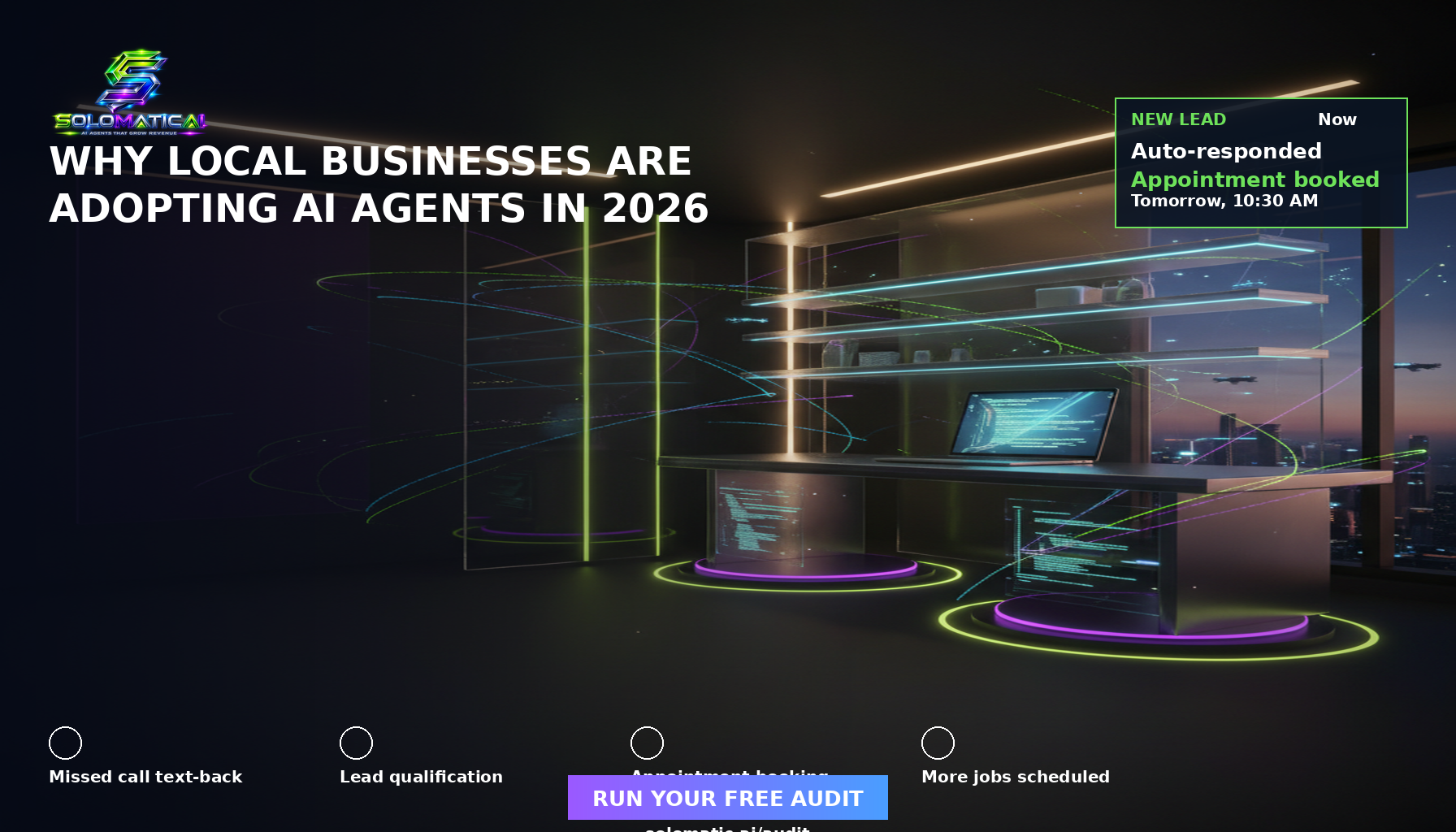
Real estate agents start with lead response automation — every website inquiry gets an immediate text response, property match, and showing booking within 60 seconds.
Home service companies start with missed-call recovery — when the office is closed or busy, AI texts the caller back, collects job details, and schedules the estimate.
Insurance agencies start with renewal outreach — automatically contacting policyholders 90, 60, and 30 days before expiration with quotes and scheduling.
Dental and medical practices start with new-patient intake — automating the paperwork, insurance verification, and scheduling process that typically loses 20% of new patients.
The Bottom Line
Local businesses aren't adopting AI because it's futuristic. They're adopting it because it recovers revenue they were already losing. The technology has crossed the threshold from "interesting experiment" to "obvious business decision."
Schedule a free strategy call to find out how much revenue your business is losing to slow response — and which AI agent should plug that leak first.